Showing posts with label Ohio history. Show all posts

Wednesday, January 11, 2012

What Ohio stands for

I was in the Ohio Statehouse yesterday, when I encountered the following quotation, which to me represents the high political ideals that Ohioans have represented through the ages. We would all do well to remember them as we work to rebuild our state and our society:

Let Ohio speak for human rights, for universal manhood suffrage, for fair and honest elections, for economy and purity in public affairs, for honest money and stable government.


Mr. Williams was the first African-American to serve in the Ohio House of Representatives, representing Cincinnati 1880-1881. In his brief life (he died at 41), he was a veteran of the War between the States (having enlisted at 14!), and was a minister, historian, and diplomat. He wrote the first history of African-Americans, and at the end of his life, launched an investigation of the mistreatment of the people of the Congo at the hands of agents of King Leopold II of Belgium. He contracted tuberculosis and pleurisy, and died in England returning from Africa. He is buried in England.

He spoke for human rights, which are enshrined in our Ohio Constitution, adopted in 1851. The Bill of Rights has expanded since then, most recently last year with the adoption of Issue 3, nullifying mandatory health care.

He spoke for universal manhood suffrage, which Ohio, unfortunately, was slow to embrace -- but finally did so with our ratification of the Fifteenth Amendment in 1870. However, Ohio redeemed itself in 1919 by becoming the sixth state to ratify the Nineteenth Amendment, extending suffrage to women.

He spoke for fair and honest elections. For most of Ohio's history, particularly during the service of Secretary of State Ted W. Brown (in office 1950-1978) and his successor Anthony J. Celebrezze, Jr (1979-1983), Ohio has had an exemplary elections process. More recently, it has been tainted by scandals involving a Secretary of State (Ken Blackwell) who actively participated in the 2004 Presidential campaign while in office, and with problems involving voting machines made by Diebold.  However, his successors Jennifer Brunner and Jon Husted have gradually restored credibility to the office.

He spoke for economy and purity in public affairs. For most of Ohio's history, the state was run economically. As recently as 1991, Ohio ranked very near the bottom of the 50 states in state tax burden. While the continuing recession has resulted in much higher taxes (to maintain steady revenues), efforts of Gov. Kasich and the Ohio General Assembly are managing the budget without further tax increases. When their efforts bear fruit, Ohio will again be working toward economy in public office. Purity in public affairs, however, is one of those ideals that can never be attained, but must always be striven for.

He spoke for honest money. In our history, Ohio has been a leader for a currency that represents value. In 1819, State Auditor Ralph Osborn attempted to enforce a tax on the Bank of the United States, in part because that bank issued currency without backing. "Sound money" is the issue that propelled Ohio's William McKinley to the Presidency. Today, many in the Ohio freedom movement are pressing for a way to protect Ohioans from a future hyperinflation by facilitating the use of gold and silver in payment of taxes and as a currency.

Finally, he spoke for stable government. To me, stable government should be boring. It consistently, day after day, enforces a small number of easily-understood laws to protect the lives, liberties, and property of Ohioans. All things considered, and particularly in comparison to other industrialized states, Ohio has done this reasonably well; but like purity in public affairs, it is a continuing struggle to maintain.

George Washington Williams's ideals are a statement of the fundamental principles of political life in Ohio, principles which we have generally applied well; but of which we must continually remind ourselves as we move forward.

Tuesday, September 20, 2011

O-H-... N-O!!!

Brutus Buckeye after the scandal
Normally, I defer to people who are more knowledgeable about sports than I am; but there are a few things that need to be said about Ohio State football that have broader implications.

I live in Columbus. It is a clean, cosmopolitan, and remarkably nice city to live in. Living anywhere comes at a price -- and the price for living in Columbus is three to four months of living with "Buckeye Fever," including the mandatory Hate Michigan Week in November. Fanatical support for Ohio State is considered a civic duty at this time of year, even if you have no connection to the university.

Being a life-long Ohioan, I do wear scarlet and gray with appropriate symbolism on occasion, and want Ohio State to have a successful season. However, this season begins with a pall over it in the wake of the firing resignation of coach Jim Tressel, and the suspensions of several of the players for accepting gifts and selling items. There is considerable doubt that Ohio State will even mount a winning season this year, having a new coach and barely defeating the University of Toledo Sept. 10.

The problem with college football is not Jim Tressel or Terrelle Pryor, or any of the players. The problem is that the system itself is fundamentally hypocritical and corrupt. On the one hand, the National Collegiate Athletic Association trumpets that it stands for the "amateurism" of the college athlete (supported by television ads showing the academic prowess of those who play sports other than football). On the other, there is no question that there is a great deal of money involved in TV contracts, gate receipts, and product placement.

Taylor Branch, at The Atlantic, likens this system to colonialism:

But after an inquiry that took me into locker rooms and ivory towers across the country, I have come to believe that sentiment blinds us to what’s before our eyes. Big-time college sports are fully commercialized. Billions of dollars flow through them each year. The NCAA makes money, and enables universities and corporations to make money, from the unpaid labor of young athletes.

Slavery analogies should be used carefully. College athletes are not slaves. Yet to survey the scene—corporations and universities enriching themselves on the backs of uncompensated young men, whose status as “student-athletes” deprives them of the right to due process guaranteed by the Constitution—is to catch an unmistakable whiff of the plantation. Perhaps a more apt metaphor is colonialism: college sports, as overseen by the NCAA, is a system imposed by well-meaning paternalists and rationalized with hoary sentiments about caring for the well-being of the colonized. But it is, nonetheless, unjust. The NCAA, in its zealous defense of bogus principles, sometimes destroys the dreams of innocent young athletes. 
Money is unquestionably a corrupting influence in college athletics; but I am not sure that the problem is best solved simply by giving the players a stipend. If handled in the same way as payments made to graduate students for serving as teaching assistants, I have no real objection to giving a stipend to college athletes; but the problem really runs much deeper than that.

We (and yes, I mean we, the spectators, alumni, and taxpayers) have allowed the athletic* tail to wag the education dog. The purpose of colleges and universities is to provide an advanced education. When athletics distracts from that mission (as it clearly has at Ohio State and many other Division I schools), it is the duty of the faculty and trustees to reassert control, as the faculty did in a rather bizarre way in 1961, when they refused permission for the Buckeyes to play in the January 1, 1962, Rose Bowl:
Within faculty circles, the question of whether Ohio State should participate in the Rose Bowl had been festering for several years. Faculty members questioned the commercial aspects of big-time football. They were concerned that OSU football overshadowed the university’s reputation as a center of learning.  To many, the Rose Bowl contributed to an overemphasis in athletics. Ohio State utilized the quarter system, making it difficult for Rose Bowl-bound students to attend classes by January 2. ...

Those opposed to the trip to California were uneasy about the public image OSU portrayed as an “athletic factory”; academic disruptions were prominent in the 1958 Rose Bowl excursion; there was concern that Buckeye boosters were really in control of athletic policy; and favoritism toward football players would occur.**
Fifty years later, the faculty's concerns are still valid; though their remedy in this instance caused more trouble than it was worth.

The solution is to impose strict academic standards on college athletes; at minimum, the same standards that apply to other students, including minimum course loads and grade point averages. Professors enforcing those standards on players in their classes should receive the complete support of the faculty, administration, and trustees. Students who can stand up academically can play. They can receive scholarships, and maybe a stipend; but academics will be first and foremost.

Do not tell me it cannot be done. Division III schools (including my alma mater, #9 Ohio Northern) have done this successfully for years -- and the football is just as exciting without the glitz.***

* In many schools, basketball is just as culpable.
** James E. Odenkirk, "The Eighth Wonder of the World: Ohio State's Rejection of a Rose Bowl Bid in 1961," Journal of Sport History 34 (Fall 2007), 389-395.
*** And just to rub salt into the wound, I can go to Ohio Northern and pay the same price for a football ticket as I did when I was a student 40 years ago ... $4.00.

Monday, September 12, 2011

The truth will make us free

... but facing it can be extremely painful. After World War II, many Germans realized that they could not move on until they accepted responsibility for having made possible the Nazi regime. They made a special effort to educate themselves on the truth of what happened, and became a strong nation again -- this time a positive force for freedom in Europe. This is not a common accomplishment. The Japanese continue to struggle with the same war; and Americans remain in denial about atrocities committed by our own troops in any war.

One of the truths about the War between the States that is particularly painful for me as an Ohioan is the character of Gen. William Tecumsah Sherman, a native of Lancaster who, by embracing the concept of "total war" made himself a mass murderer -- not only of Southerners, but also of Plains Indians after the war. He was ably aided in this effort by another Ohio-born general, Philip Sheridan (from Somerset in Perry County), who wrought vast destruction in the Shendandoah Valley of Virginia, and in the West. To justify these acts as "military necessity" is to say that the end justifies the means, a position that is never morally defensible.

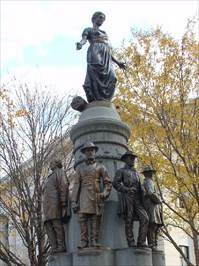
"These are My Jewels," The lady on top is Cornelia, representing Ohio


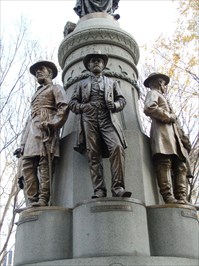
Evidence that we are in denial? Statues of both men appear in the monument "These Are My Jewels" in the Ohio Statehouse lawn, along with that of Edwin Stanton (from Steubenville), who acted as a virtual dictator of the United States with Congressional support. President Andrew Johnson was little more than a figurehead. [The other four figures on the statue are Gens. Ulysses S. Grant (from Point Pleasant and Georgetown), Rutherford B. Hayes (native of Delaware, Ohio, later of Fremont) and James A. Garfield (from Mentor), all later to become President of the United States; and Ohio Governor, Secretary of the Treasury, and later Chief Justice Salmon P. Chase, a resident of Cincinnati prior to entering Lincoln's cabinet.]

Detail. Left to right: Gens. William T. Sherman, Ulysses S. Grant, and Philip Sheridan

No one wants to face the shameful acts of one's own people; but until we do, we will not embrace truth. As long as we choose to live in lies, we will find ourselves enslaved by them.

Friday, April 29, 2011

Prince William is one of us (well, a little bit anyway)

Franklin H. Work

Totally off-topic, but in celebration of Wills and Kate tying the knot today, here's a bit of trivia for you. William's great-great-great grandfather was born in Chillicothe, Ohio. Here's the lineage, from the I Dream of Genealogy website and RootsWeb.

PRINCE WILLIAM OF WALES, b. June 4, 1982, married April 29, 2011 to Catherine MIDDLETON, b. January 9, 1982.

Mother: Diana Frances SPENCER (1961-1997), married 1981 to CHARLES, PRINCE OF WALES (1948--), divorced 1996.

Grandmother: Frances Ruth BURKE-ROCHE, married 1954 to Edward John Spencer.


Great-Grandfather: Edmund Maurice BURKE-ROCHE, b. 1885 Chelsea, England, d. 1955 King's Lynn, England

Great-Great-Grandmother: Frances B. WORK, b. 1857 New York, d. 1947 New York; married James Boothby BURKE-ROCHE

Great-Great-Great-Grandfather: Franklin H. WORK, b. February 10, 1819 Chillicothe, Ohio, d. March 16, 1911 New York.